
GST E-Invoicing Rules & Latest Applicability Thresholds (Official Guide)

By Revenue Dynamics Tax Advisory
Published: 27 November 2025
Category: GST/Compliance
1. Executive Summary
E-Invoicing has become a critical GST compliance requirement for medium and large businesses in India. It ensures real-time invoice authentication, prevents fraudulent ITC claims, and helps automate reporting.
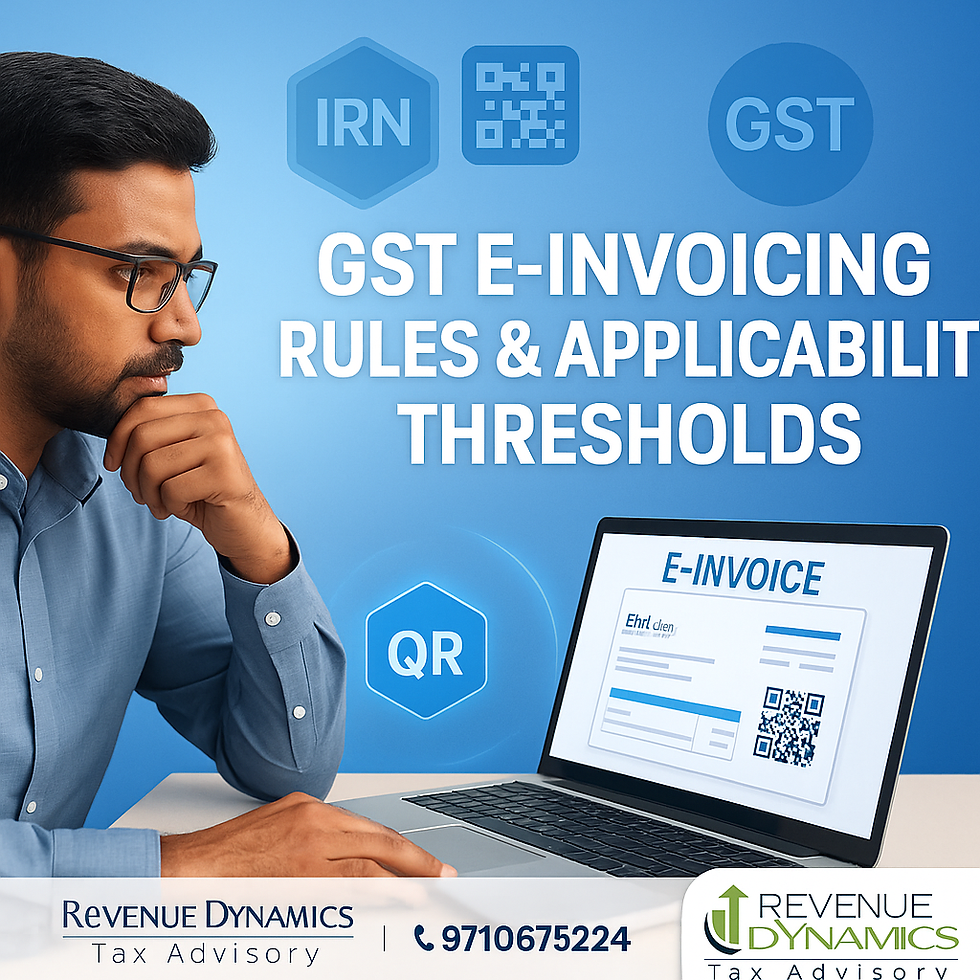
This guide explains:
✔ What e-invoicing really is
✔ Who must follow it
✔ The latest official threshold
✔ Exemptions
✔ Step-by-step process
✔ Penalties & mistakes
✔ RDTA expert tips
Clear, simple, and updated.
2. What is E-Invoicing Under GST?
E-invoicing does NOT mean issuing invoices on the GST portal.
It means your billing system must send invoice details to the Invoice Registration Portal (IRP) → IRP validates → assigns:
✔ IRN (Invoice Reference Number)
✔ QR Code
Your invoice must display both for it to be valid.
E-invoicing applies only to B2B, export, and B2G invoices.
3. GST E-Invoicing Applicability — Latest Official Threshold
✔ Applicability is based on Aggregate Turnover (PAN-India).
Annual Aggregate Turnover (PAN Based) | E-Invoicing Applicability |
Above ₹500 Crore | Mandatory (from Oct 2020) |
Above ₹100 Crore | Mandatory (from Jan 2021) |
Above ₹50 Crore | Mandatory |
Above ₹20 Crore | Mandatory |
Above ₹10 Crore | Mandatory |
Above ₹5 Crore | Latest mandatory threshold (as per Notification No. 10/2023 – CT, effective 01-Aug-2023) |
📌 There is NO official announcement of the threshold being reduced to ₹1 crore.
Many blogs speculate this, but CBIC has not issued any new notification.
We at RDTA ALWAYS use only official sources.
4. How to Check Whether E-Invoicing Applies to Your Business
✔ Method 1: Official Portal Checker
Enter your GSTIN → Instantly shows applicability.
✔ Method 2: PAN-based Turnover Calculation
Include:
✔ Taxable supplies
✔ Exempt supplies
✔ Exports
✔ State-wise units
✔ Method 3: Check for Exempt Categories
Even for turnover above ₹5 Cr, some businesses are fully exempt.
5. Who Is Exempt from E-Invoicing? (Regardless of Turnover)
✔ SEZ Units
✔ Banks
✔ NBFCs
✔ Insurance Companies
✔ Goods Transport Agencies (GTA)
✔ Passenger Transport Service Providers
✔ Multiplex/Cinema Screen Exhibitors
✔ Government Departments
These entities do not need to issue e-invoices.
6. Step-by-Step Process to Generate E-Invoices
Step 1 — Enable E-Invoicing
Log in to the GST portal → Search “e-invoice enablement” → Submit GSTIN.
Step 2 — Use Software with IRP Integration
ERP / Tally / Zoho / Busy / Odoo / custom API systems.
Step 3 — Create an Invoice in Your Accounting Software
Step 4 — IRP Validation Happens Automatically
Your software pushes the invoice → IRP returns IRN + QR code.
Step 5 — Print the QR Code on the Invoice
Missing QR code → invoice invalid.
Step 6 — Auto population
✔ Auto-fills GSTR-1
✔ Auto-fills E-Way Bill fields
7. Penalties for Missing E-Invoicing
Non-Compliance | Penalty |
Not generating an e-invoice | ₹10,000 per invoice |
Missing QR code / IRN | The invoice becomes invalid |
Buyer ITC issues | The buyer may lose input credit |
E-way bill mismatch | Vehicle detention |
GST department notice | High financial risk |
8. Common Mistakes Businesses Make (And How RDTA Fixes Them)
❌ Software not updated
❌ Missing mandatory fields
❌ Late IRN generation
❌ Duplicate IRN
❌ Confusion between B2B and B2C
❌ Invoice mismatch with GSTR-1
RDTA Solutions:
✔ Smooth e-invoice setup
✔ Software integration
✔ Monthly audit
✔ Invoice verification
✔ GSTR-1 and E-Way Bill reconciliation
✔ Staff training
✔ Avoiding penalties proactively
9. RDTA Expert Advice — How We Help
We ensure your business stays fully compliant with:
✔ E-invoice activation
✔ Setup & testing
✔ B2B invoice mapping
✔ Real-time IRN validation
✔ Automated invoice flow
✔ GST return alignment
✔ Professional monthly review
Your business stays focused on operations while RDTA handles the compliance load.
10. FAQs
Q1. Does e-invoicing apply to B2C invoices?
No, only B2B, B2G, and exports.
Q2. Can IRN be cancelled?
Yes, within 24 hours of generation.
Q3. Do credit notes also require IRN?
Yes, if the supplier is under e-invoicing.
Q4. Is the e-way bill still needed?
Yes — the system auto-populates parts of it.
Q5. How do I know if my supplier has generated an IRN?
Scan the QR code or check via the IRP/GST portal.
11. Conclusion
E-Invoicing under GST is now mandatory for all businesses with a turnover above ₹5 Cr. Understanding the rules, process, and compliance requirements ensures your business avoids penalties, stays audit-proof, and keeps the ITC flow smooth.
RDTA helps businesses adopt e-invoicing the right way — without errors.
12. CTA – Work With RDTA
Still confused about your turnover & applicability.
📞 +91 97106 75224🌐 www.rdtaxadvisory.in📧 info@rdtaxadvisory.in

Comments